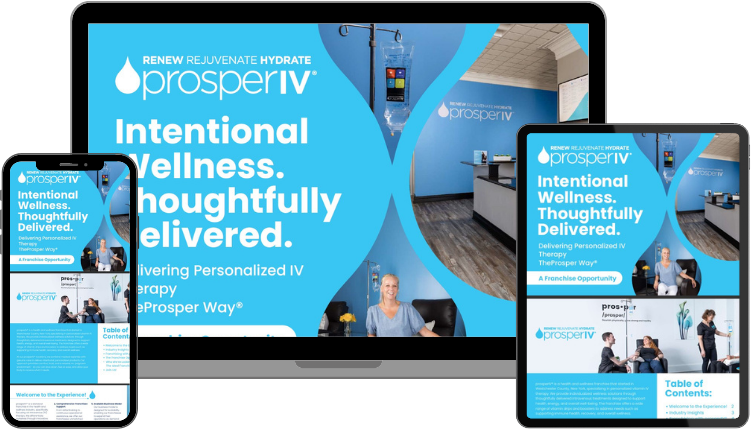
Thinking about an IV therapy business? Start here.
The first time someone experiences IV therapy, they are not thinking about business models.
They are thinking about how they feel.
Energy comes back. Focus sharpens. The body begins to reset in a way that feels immediate and noticeable. For many, it is the first time they have felt that level of recovery in a long time.
And somewhere in that moment, a quieter thought begins to form.
Why isn’t this more accessible?
Why doesn’t this exist everywhere?
Could I build something like this?
That question has fueled the rapid growth of the IV therapy space. What was once a niche has quickly become part of a broader shift toward preventative health, recovery, and lifestyle wellness.
But as more entrepreneurs begin exploring the opportunity, something becomes clear almost immediately.
This is not one business model.
It is a category made up of very different approaches, each with its own strengths, limitations, and long-term implications.
A Growing Category With Very Different Paths
From the outside, most IV therapy businesses appear similar. The service itself does not change dramatically from one location to another.
What changes, often in ways that are less visible at first, is how the business operates.
Some models are built for speed and accessibility. Others are designed for structure and volume. A smaller but growing segment is built around experience, brand, and long-term differentiation.
Each path can work. But they do not scale, perform, or compete in the same way.
A Day That Changes the Way You See the Business
It was a Tuesday afternoon.
A customer walked in after a long week of travel. I could see it in their posture before they even said a word. Tired. A little run down. Not quite themselves.
We greeted them and guided them into a space that felt calm and intentional. Not clinical. Not rushed. The lighting was softer than they expected. The pace was slower.
A nurse walked them through everything, answered questions without rushing, and made sure they felt comfortable before anything began.
About thirty minutes later, something shifted.
They sat up a little straighter. Their expression changed. You could see the relief set in.
And before they left, they asked when they should come back.
It’s a small moment. Easy to overlook.
But it’s the entire business.
Because what just happened wasn’t just a service. It was an experience. One that created trust, comfort, and a real reason to return.
And that’s the difference between businesses that grow steadily… and the ones that struggle to stand out.
Mobile IV Therapy: Flexibility With Limits
For many first-time owners, mobile IV therapy feels like the most natural entry point.
There is a certain appeal to the simplicity of it. Lower upfront costs. No physical space to manage. The ability to bring the service directly to the customer.
In the early stages, this flexibility can be a real advantage.
Over time, though, the structure of the model begins to shape the business in more noticeable ways.
Growth often requires adding more providers rather than improving efficiency. Scheduling becomes more complex. Travel time limits how many appointments can realistically happen in a day.
What starts as flexible can become difficult to scale.
Retail Drip Bars: Structure Without Differentiation
The next step for many in the category is a fixed-location drip bar.
Customers come to you. The business feels more predictable. Volume increases.
But as more drip bars enter the market, something shifts.
From the customer’s perspective, many begin to look and feel the same.
The experience becomes less about preference and more about convenience.
And when that happens, pricing pressure follows. Loyalty weakens. Growth becomes tied to volume instead of brand strength.
Premium IV Therapy: Where the Category Is Heading
A more intentional model is emerging.
One that starts not with speed, but with experience.
In this model, the environment matters. The interaction matters. The feeling a customer leaves with matters just as much as the treatment itself.
Customers are not simply stopping in.
They are choosing where they feel most comfortable. Where they trust the process. Where they want to return.
That shift changes the business entirely.
Retention improves. Referrals become natural. The brand begins to carry weight.
And in a growing category, that differentiation becomes one of the most valuable assets an owner can have.
The Decision Behind the Decision
When evaluating an IV therapy franchise, most people naturally focus on the surface-level questions.
- What does it cost to start?
- How quickly can it launch?
- How complex will it be to operate day to day?
Those are valid considerations. They shape your entry into the business, but they don’t define where it goes. The more meaningful decision sits just beneath those questions. It’s the decision between building something that depends on constant activity, or something that continues to grow because of how it’s built.
A transactional model can work. It can generate revenue. It can stay busy.
But it often relies on volume to sustain itself. More appointments. More customers. More effort.
A brand-driven model works differently. It builds momentum over time. Customers return. They recommend it to others. The experience itself becomes part of the value.
That distinction may not feel significant in the early stages.
But over time, it becomes the difference between maintaining a business…and building one that expands.
What to Look for When Evaluating a Franchise
A strong IV therapy franchise should provide clarity in the areas that tend to feel the most uncertain for new owners.
Staffing and medical oversight are at the center of that.
In many states, IV therapy services must be administered by licensed professionals and operate under the direction of a qualified medical director .
That structure is not optional. It is foundational.
The question is whether the franchise helps you navigate it.
You should understand:
- How medical professionals are integrated into the business
- How responsibilities are divided between clinical and non-clinical operations
- What your role is as the owner, especially if you are not a healthcare provider
In many cases, franchisees operate as a management services organization, while licensed professionals handle the clinical side of care. That distinction matters. It shapes how the business is built and scaled.
Compliance is another critical layer.
You are required to operate within federal, state, and local healthcare regulations, and in some cases, you must engage legal counsel to ensure compliance before opening .
Without structure, that can feel overwhelming.
With the right system, it becomes manageable.
Then there is the brand itself.
In a fragmented market, where many providers offer similar services, the ability to create a consistent, recognizable experience becomes a true differentiator.
And finally, scalability.
Some IV therapy businesses depend heavily on the owner’s daily involvement.
Others are built with systems, training, and operational frameworks that allow the business to expand beyond a single location.
Understanding that difference early can change the entire trajectory of what you build.
Where Many IV Therapy Concepts Fall Short
As the industry has expanded, many concepts have focused on accessibility.
Shorter visits. Faster turnover. Easier entry points for customers.
Those decisions can drive early traction. They make the service more available, more visible, and easier to try. But over time, something begins to erode.
Consistency becomes harder to maintain. The experience starts to feel less intentional. The brand becomes less defined.
Some customers may still come in. But the connection is weaker. And without that connection, something important is missing.
That lack of return behavior creates pressure on the business. Growth becomes dependent on continuously finding new customers rather than building a base that returns on its own.
It’s not always obvious at the beginning. But it becomes very clear over time.
Where prosperIV™ Fits Within the Category
prosperIV™ is built with those challenges in mind.
The model is not just about offering IV therapy. It is about delivering it within a structured, repeatable system that supports both the clinical and experiential sides of the business.
Services are delivered under the direction of qualified medical professionals, within a defined operational framework that separates clinical care from business management.
At the same time, the environment is intentionally designed to feel like a spa rather than a clinical setting, creating a more comfortable and elevated experience for customers.
That combination matters. It creates trust without feeling clinical. It also creates structure without feeling rigid. And for owners, it creates a different kind of opportunity. One in which you are not starting from scratch. In fact, with prosperIV™, you are stepping into a system that defines:
- How the space looks and operates
- How services are delivered
- How the brand is experienced by customers
That allows you to focus on building the business itself. Not figuring out how to piece it together. Over time, that clarity becomes a competitive advantage.
Choosing a Path That Matches What You Want to Build
Each IV therapy model offers a different path forward.
Some prioritize flexibility and speed. They allow you to enter the market quickly and begin operating with fewer upfront commitments.
Others focus on structure and volume, creating a more predictable daily rhythm and the ability to serve more customers in a set environment.
And some are designed with long-term brand development in mind, where the goal is not just to operate, but to create something that grows in recognition and value over time.
None of these paths are inherently wrong.
But they lead to very different outcomes.
The right choice comes down to what you want the business to become, not just how you want it to start.
Where This Can Lead
Most people do not remember the details of their IV treatment.
They don’t remember the exact formulation or the timing.
They remember how they felt.
They remember the moment something shifted. When the fatigue lifted. When they felt more like themselves again.
The businesses that succeed in this category understand that the experience is what makes that moment possible.
They do not just deliver hydration.
They create an environment where people feel better, both physically and mentally, and where that feeling becomes something they want to return to.
When that experience is delivered consistently, it begins to build something larger.
It becomes more than repeat visits. It becomes recognition.
More than transactions. It becomes trust.
And over time, that becomes the foundation of a business that grows with intention, rather than one that has to constantly chase its next customer.
Exploring What Comes Next
If you are considering entering the IV therapy space, the next step is not just choosing a category.
It is understanding how a model supports the kind of business you want to build.
Exploring the prosperIV™ franchise opportunity offers a closer look at how a premium, experience-driven model is structured, and what it takes to bring it to life.
FAQs
What is an IV therapy franchise?
An IV therapy franchise is a business model that provides intravenous hydration and nutrient treatments within a structured system that includes branding, training, and operational support.
What is a drip bar franchise?
A drip bar franchise is a physical location where customers visit for IV therapy services, typically in a retail-style setting.
Do you need medical experience to own an IV therapy franchise?
Many systems allow non-medical owners, though licensed professionals are required to administer treatments and oversee care.
How much does an IV therapy franchise cost?
Costs vary depending on the model, location, and buildout requirements.
What licenses are required for IV therapy businesses?
Requirements vary by state but often include medical oversight, licensed staff, and compliance with healthcare regulations.